
Philately and Espionage
A Century of Crime, Part 7


This week on Murder at the Manse, I’m continuing my long-term goal of reading one crime novel from the 20th century, in order. You can follow my journey so far here. With today’s entry, we finally reach 1920! So you can expect some more familiar Golden Age authors in the posts to come. For the years 1918—1920, I’ve been reading some very productive writers telling tales that take us into the worlds of expensive parties, stamp-collecting and espionage…

Vicky Van is one of New York’s social butterflies, regularly hosting memorable parties at her home, which is “quietly and in the best of taste luxurious”. At one of these parties, a guest brings along a friend, Mr Somers the millionaire. Somers inadvertently becomes a bit of a party pooper when he dies from a fatal stab wound. Suspicion falls on Vicky Van herself, largely because she disappears immediately afterwards. Chester Calhoun, the book’s narrator and an admirer of Vicky, hopes to find Vicky and demonstrate her innocence.
Carolyn Wells was a prolific author, who was responsible for 170 books, a significant proportion of which were mysteries. She was prompted to start writing in the mystery genre after hearing a story by Anna Katharine Green read aloud. According to her New York Times obituary, “She had always loved puzzles… and this type of ‘puzzle story’ captivated her imagination at once.”1 As well as writing fiction, she produced the first book-length treatment of detective fiction, The Technique of the Mystery Story in 1913. Reassuringly, in this book she comments: “A liking for mystery fiction is not a mark of poor taste or an indication of inferior intellect.”2
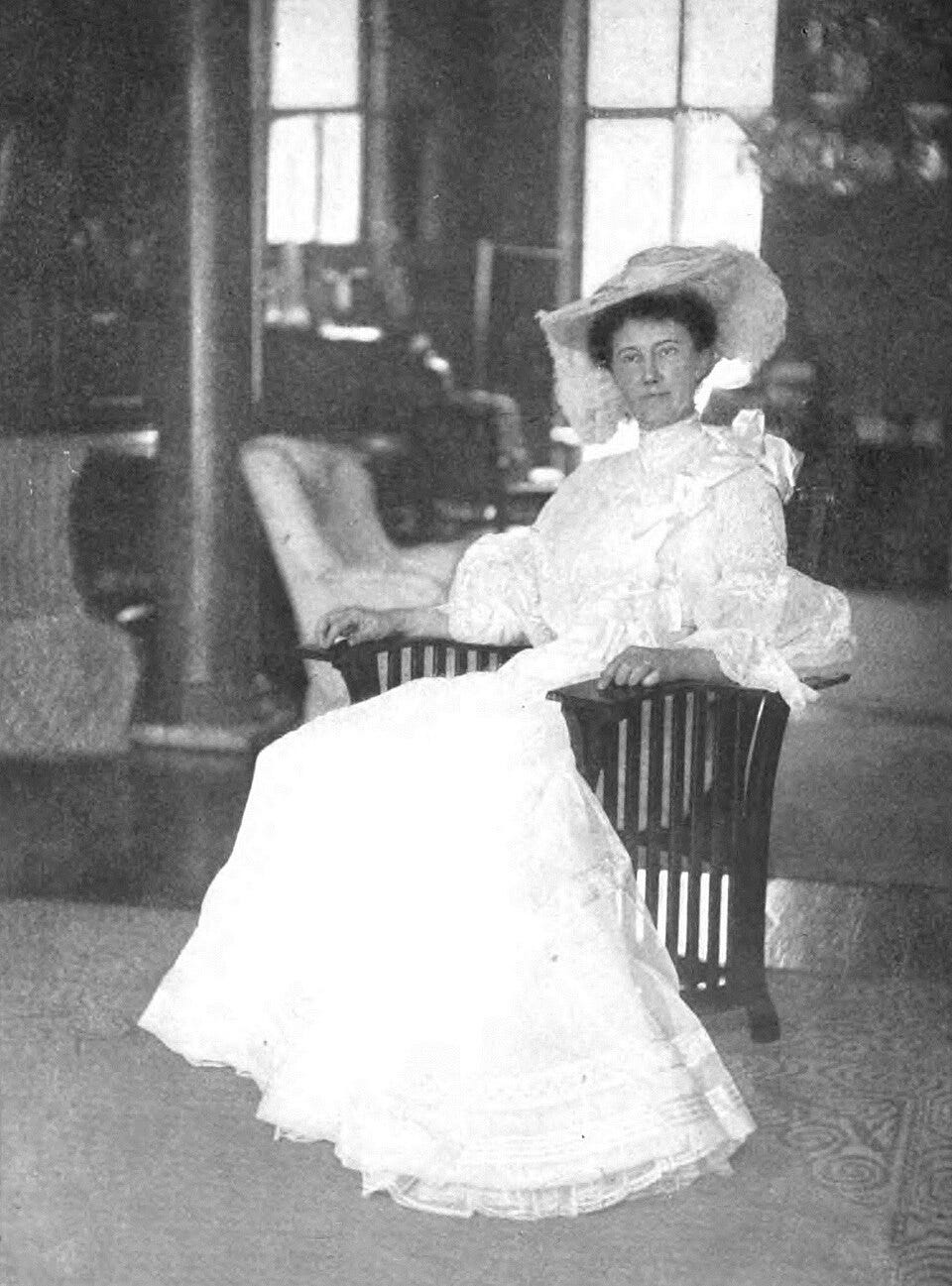

Vicky Van is the ninth novel to feature Carolyn Wells’ main detective, Fleming Stone. Mr Stone first appeared in a short story in 1906 and continued detecting until the year of his creator’s death, 1942. Within the world of the novel, he has a reputation as “the great detective”, “a wonder”. He is also described by the narrator as “the most magnetically attractive man I had ever seen”. In the end, though, it is Stone’s assistant Fibsy who solves the mystery. Given the conventions of fictional detective assistants, it’s notable that Stone is keen to praise Fibsy’s work: “I couldn’t believe it, myself, when Fibsy hinted it to me—for it’s his find—to him belongs all the credit.”
The writing is in many ways fairly unremarkable, but Carolyn Wells does give us an entertaining plot involving two related mysteries — the murder and the disappearance. Chester Calhoun is an intriguing narrator, although a less-than-competent detective. When the absent Vicky Van communicates with him, he has to decide when this information becomes shareworthy: “Should absolute law and justice call for that information, I might give it up, but at present, I was awaiting developments.” The intrigue concludes with a fun twist. You’ll probably guess it before the end, but it’s still very pleasing.
Verdict: ⭐⭐⭐ (3/5)
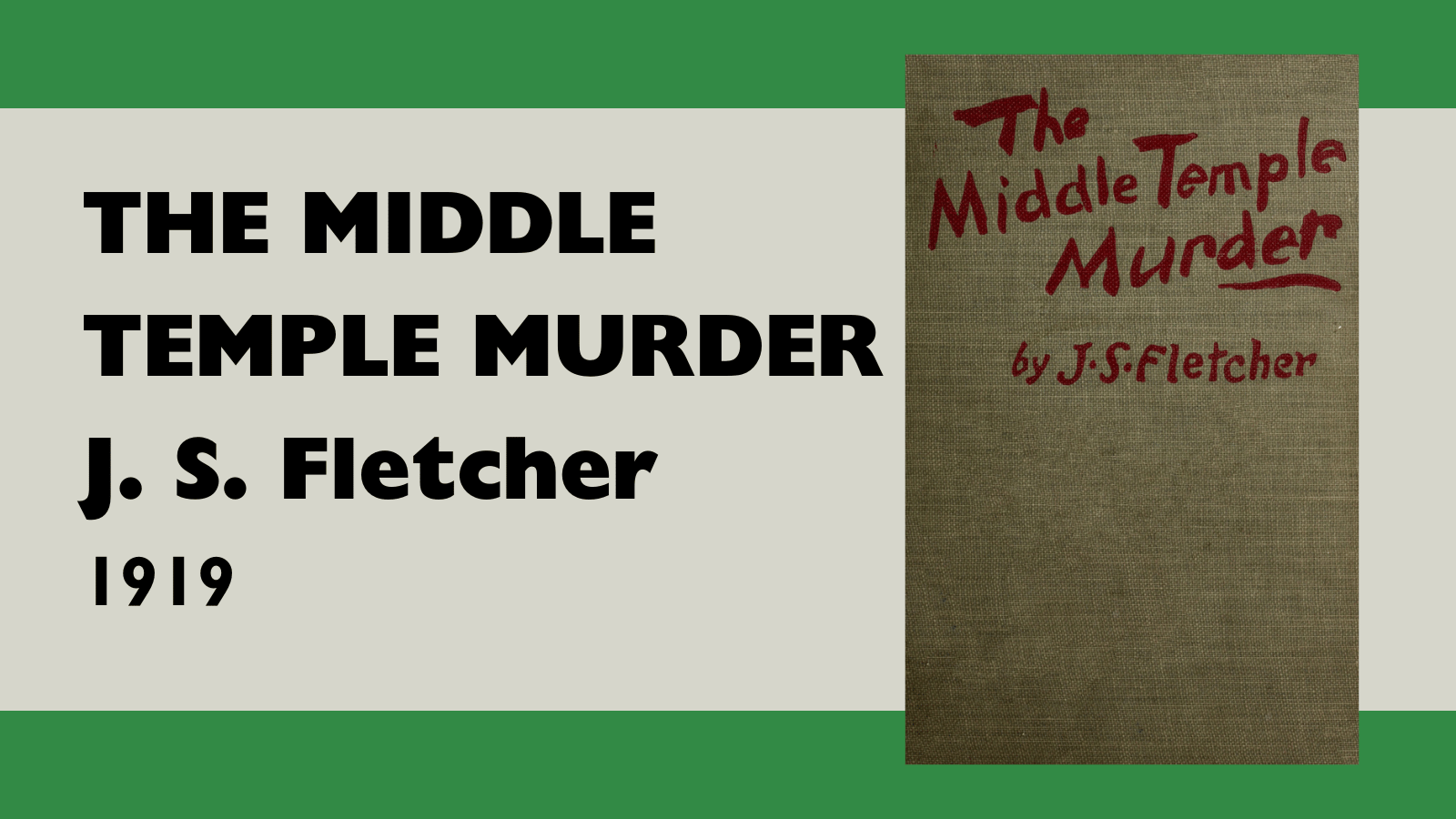
Walking home from his Fleet Street office, journalist Frank Spargo finds himself inspecting a dead body at the entrance to some chambers in Middle Temple. The only clue to the victim’s identity is a piece of paper in his waistcoat pocket bearing the address of barrister Ronald Breton. Spargo works in tandem with Inspector Rathbury to investigate the man’s death, and their investigation soon moves beyond the Middle Temple to encompass the House of Commons and the world of philately. It transpires that the man is an old friend of MP Stephen Aylmore, who has recently returned from Australia, bringing with him “an exceedingly rare, exceeding valuable set of Colonial stamps”. Spargo will have to do some digging in the past, and in the distant land of Yorkshire, before he uncovers the truth.
The Middle Temple Murder is one of the best-remembered entries in Joseph Fletcher’s bibliography, which includes over 200 books in various genres, both fiction and non-fiction. Part of the book’s success was due to a presidential endorsement when Woodrow Wilson read it while recovering from illness.3 Fletcher’s earlier mystery novels did not feature a series detective, but in the 1930s he created Ronald Camberwell, who featured in eleven novels, the last of which was completed posthumously by crossword compiler Torquemada.4 Despite his large output, Fletcher’s literary contributions have sometimes been neglected, although he was honoured with a blue plaque at his childhood home in Darrington, near Pontefract, last year.5 His writing also inspired his son Valentine to become an author — among other books, Valentine wrote an authoritative work on British domestic chimney pots, the 1969 classic Chimney Pots and Stacks.6

Overall, The Middle Temple Murder is a very well-constructed classic detective story. The plot moves at a good pace, with fresh clues regularly emerging to take the investigation in new directions. Fletcher tantalisingly leads us through multiple successive mysteries, beginning with the man’s identity, and then his movements, and then his background, and then his demise. The puzzle is revealed piece-by-piece, leading to a surprising final picture when all the pieces are put together. This final picture is arguably revealed a bit too quickly and abruptly, but it is still a satisfying solution.
Fletcher also gives us an interesting cast of distinct characters from different walks of life, most memorably Spargo himself. Spargo is a shrewd journalist, whose reporting on the murder receives high praise: “It’s a hundred thousand times better than the usual cut-and-dried account of a murder. It’s—it’s like a—a romance!” He’s also a diligent and likeable detective. The respectful partnership between Spargo and Inspector Rathbury contrasts with the rivalry one might expect: Spargo is the main detective character, but Rathbury has important contributions to make. I wish Fletcher had given us more Spargo stories, but he did at least give us one excellent case.
Verdict: ⭐⭐⭐⭐(4/5)
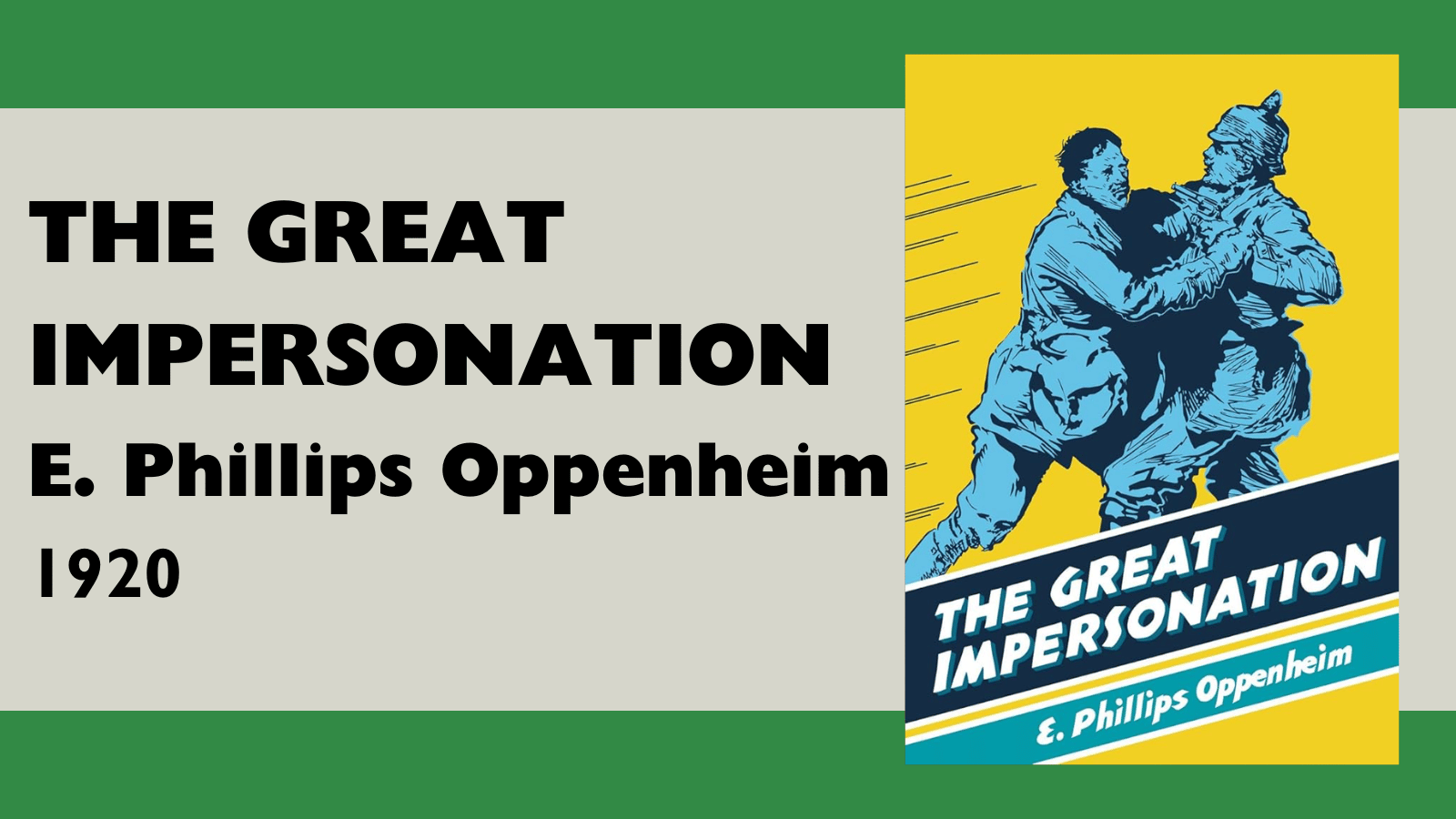
A classic entry in the annals of spy fiction, The Great Impersonation follows the story of a great impersonation.7 While in German East Africa, Baron von Ragastein meets an old English acquaintance, Sir Everard Dominey. The two men are strikingly similar in appearance, and von Ragastein exploits this fact for espionage purposes. He decides to fatally dispatch Dominey and then impersonate him in order to infiltrate the British establishment. The mission is complicated by the fact that Dominey had fled England under a cloud, suspected of murder and consequently triggering his wife’s mental breakdown. The plot unfolds in the lead-up to the First World War, against a changing backdrop of Anglo-German relations.
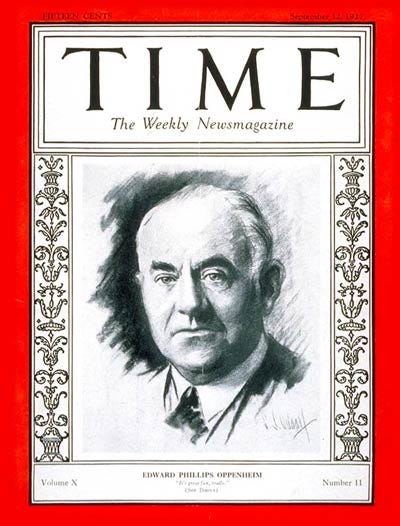
Like Carolyn Wells and J. S. Fletcher, E. Phillips Oppenheim was a prolific writer, responsible for around 150 novels. He became much more successful than either Wells or Fletcher, though, earning large royalties and gaining the nickname “the Prince of Storytellers”, as well as meriting a spot on the cover of Time magazine in 1927. An unsuccessful applicant for the Secret Intelligence Service, Oppenheim specialised in tales of international intrigue. The Great Impersonation was one of the most popular examples, selling one million copies in the first year.8 It also appeared on The Guardian’s 2009 list of “1000 Novels Everyone Must Read”.9 Behind his success was a fairly disordered writing method: Rather than planning the whole plot carefully in advance, he claimed to start each novel with just a sense of “the first chapter, and an inkling of something to follow.”10
When I started The Great Impersonation, I didn’t have particularly high expectations. I normally find espionage novels wearisome, but I still wanted to read some Oppenheim as part of my 20th-century journey given his stature. In the end, I found the book more enjoyable than first anticipated, largely because the spy narrative was accompanied (and sometimes overshadowed) by other elements of mystery. There are multiple layers to the plot — alongside the international intrigue, there’s the domestic intrigue of Everard’s wife, the criminal intrigue of the alleged murder, and the mystery of what really happened in Africa. Throughout, Oppenheim creates suspense with the doppelganger theme, with different characters having varying perspectives on the truth.
Given how many novels he wrote, it’s impressive that Oppenheim was willing to mix so many different ingredients into one book. Arguably, though, this means there is too much going on, and some of it is a bit ridiculous. And the surprise ending is completely predictable from about chapter 5 onwards. Not an overly compelling read, but still a fun adventure.
Verdict: ⭐⭐⭐ (3/5)
Scavenger Hunt item: A revolver
Join me again in a few months when we’ll look at the next three books in my century-long adventure: The Ponson Case by Freeman Wills Crofts (1921), The Red Redmaynes by Eden Phillpotts (1922) and The Abbey Court Murder by Annie Haynes (1923).
Martin Edwards, The Story of Classic Crime in 100 Books (British Library, 2017), page 42.
Edwards, The Story of Classic Crime, page 43.
As described in this Wakefield Express article. The other people honoured with blue plaques at the same time were book illustrator Charles Pears and the Perfect family of Pontefract.
Fletcher helpfully summarises:
“The principles underlying the design of these chimney-pots may be stated as follows:
To increase the velocity of ascent of the smoke by reducing the cross-sectional area of the outlet.
To minimize the effect of down-draught by reducing the area acted on by wind.
To promote up-draught by creating a cross-draught inside the upper part of the chimney.”
My edition was published in the British Library Spy Classics series, which seems to have been much more short-lived than its ongoing crime counterpart.
Martin Edwards, The Life of Crime (HarperCollins, 2022), page 144.
It has never been clear what punishment The Guardian intends to inflict if you defy their command and do not read these 1000 novels.
Quoted in Oppenheim’s entry in Twentieth-Century Crime and Mystery Writers, 3rd edition (St James Press, 1991), page 822.