
Double Detection
Forgotten Book #4

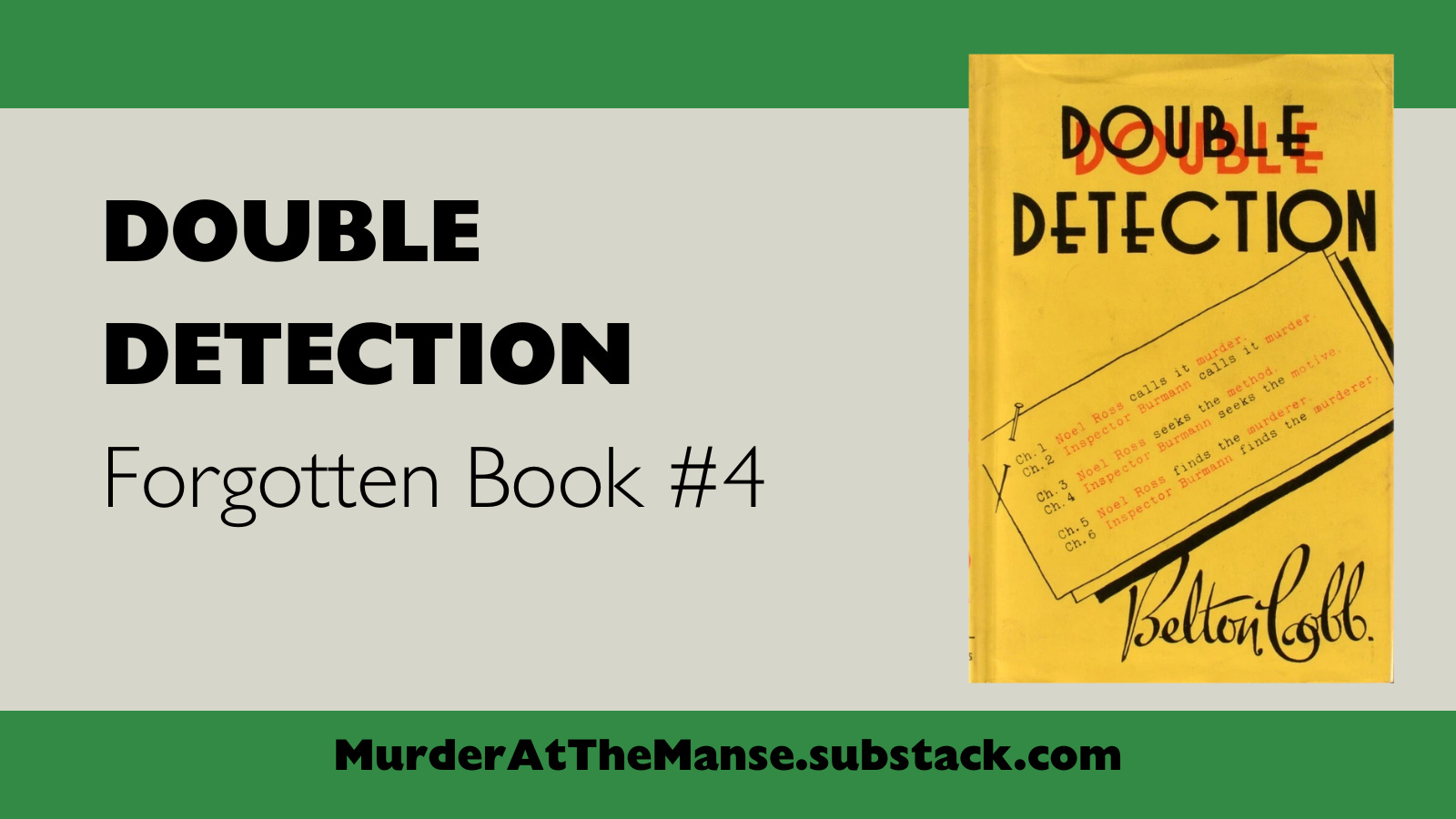
This is the fourth instalment of my occasional Forgotten Book series, where I’m opening some of the lesser-known books from my TBR shelves. Today, we’ll be looking at the Belton Cobb book Double Detection (1945), which was a random second-hand purchase because I liked the cover. I have now become the first person to give this a rating on Goodreads, although there are a couple of other online reviews by Puzzle Doctor and Neeru.
TL;DR — This is definitely a novel that deserves a reprint.
Introducing Belton Cobb
Geoffrey Belton Cobb was born in 1892, the same year as American writer James Cain, though Cobb was a native of the less hardboiled town of Tunbridge Wells in South East England.1 Cobb’s father was a writer who published around 78 novels, including some detective fiction, as well as hundreds of short stories.2 Belton Cobb followed his father into the book trade, initially working in publishing, at one point serving as Sales Director of Longmans.3 He wrote his first novel, A Stand to Arms, during the First World War, illustrated by his sister Ruth.4 This was a semi-autobiographical account of his service in the London Irish Rifles, including his involvement in the 1915 Battle of Loos.5 It was another 20 years, though, before Cobb’s writing career properly began, with the publication of his first detective novel, No Alibi.
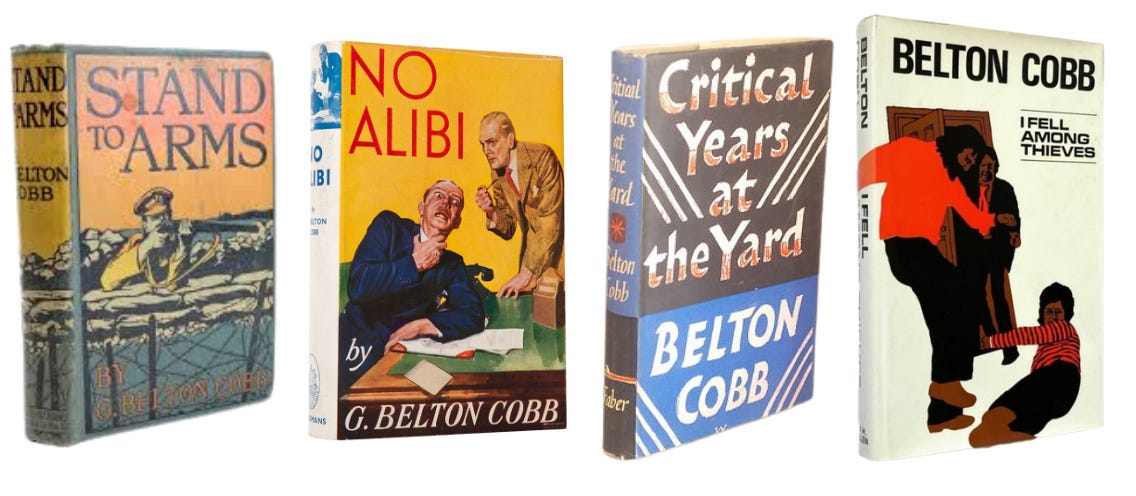
Having started writing crime fiction, Cobb had no intention of stopping. He wrote a total of 54 crime novels, the final two appearing in the year of his death, 1971.6 Some of these were adapted as radio plays for the BBC, and several were translated into French and Italian. He counted Anthony Berkeley among his admirers, and John Dickson Carr among his detractors.7 In the 1950s and 1960s, he also wrote a few non-fiction books about the history of policing and criminal justice. In 1967, a biographical note to one of his articles in The Police Journal said his books The First Detectives and Critical Years at the Yard “should be in every police library”.8
Cobb’s main series detective was Inspector Cheviot Burmann, who appeared in most of his novels. His other main recurring characters were Bryan Armitage and Superintendent Manning, with some novels featuring more than one of these sleuths. Double Detection was a Burmann title, although it also includes Noel Ross, who had previously appeared in Ross In Disguise (1940) and made a return in 1946 with Death in the 13th Dose.9 In the original edition of Twentieth-Century Crime and Mystery Writers, Daniel P. King summarised his output thus: “Belton Cobb’s earlier books are the better: as his output increased, his style seemed increasingly pedestrian and dreary.”10 Cobb was excised from subsequent editions, which perhaps reflects his drift into obscurity.11
Inside Double Detection
On the encouragement of his doctor and his wife June, Noel Ross has reluctantly headed to the coastal resort of Maytown-on-Sands to recover after an operation. Noel is unimpressed with what he finds on arrival at the White Cliffs Hotel:
Rather to my surprise, there were people in the lounge. Three men and a woman. They appeared to be waiting with grim hopelessness for death. And by the look of them they wouldn’t have to wait long… I swore that not even June should keep me there after I had had my tea and buns.
His seaside convalescence becomes a more attractive prospect when one of the other hotel guests is found dead in a locked room, and Noel suspects murder. Of course, for many people, a murder in your hotel is good reason to leave a bad TripAdvisor review. But for Noel it’s just what the doctor should have ordered:
That old fool of a doctor of ours didn’t suggest a murder as part of my treatment, simply because he hasn’t enough imagination to think of it. If he had thought of it, even he would have realized that it is just the thing to set me right. It gives me something besides my own inside to think about.
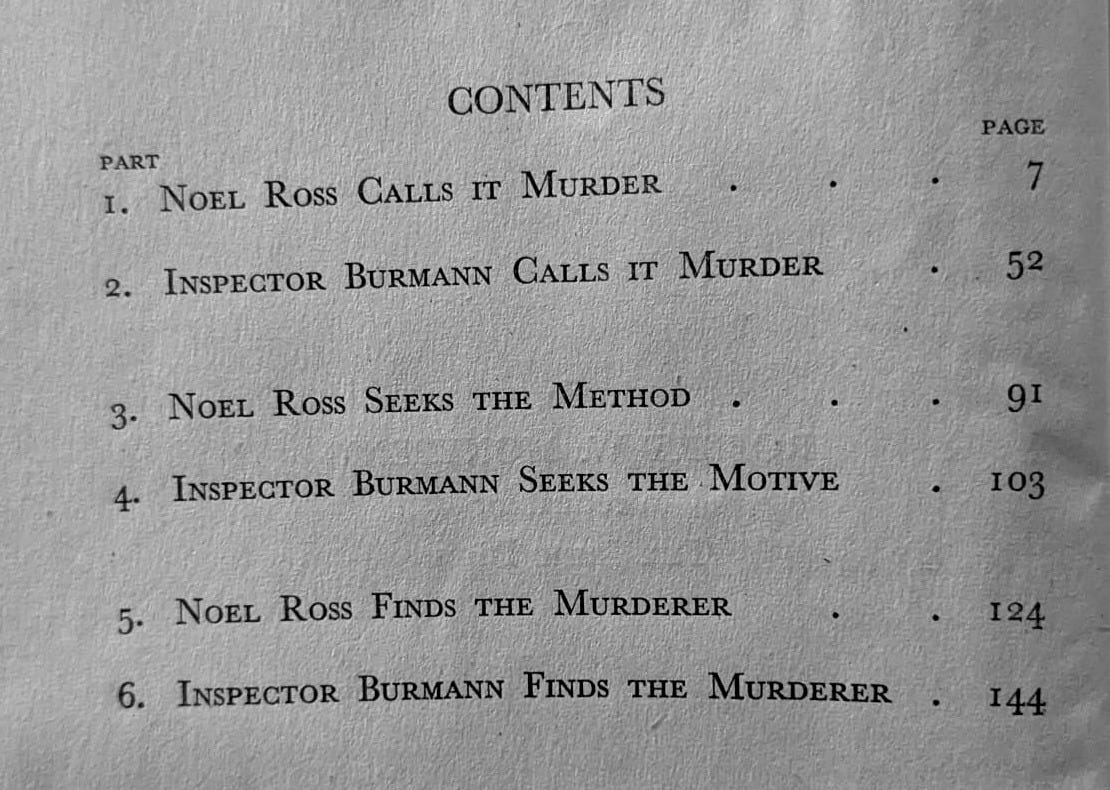
We later learn that Noel is a former Scotland Yard detective-sergeant, and his unofficial investigation runs in parallel with the official activities of Inspector Cheviot Burmann, who originally arrived on the south coast while pursuing a lead for another case. Burmann and Ross represent the “double detection” of the title, with the novel’s six sections alternating between Ross’s first-person narrative and a third-person account of Burmann’s actions. This interesting structure, and the relationship between the double detectives, makes Double Detection an especially great read.
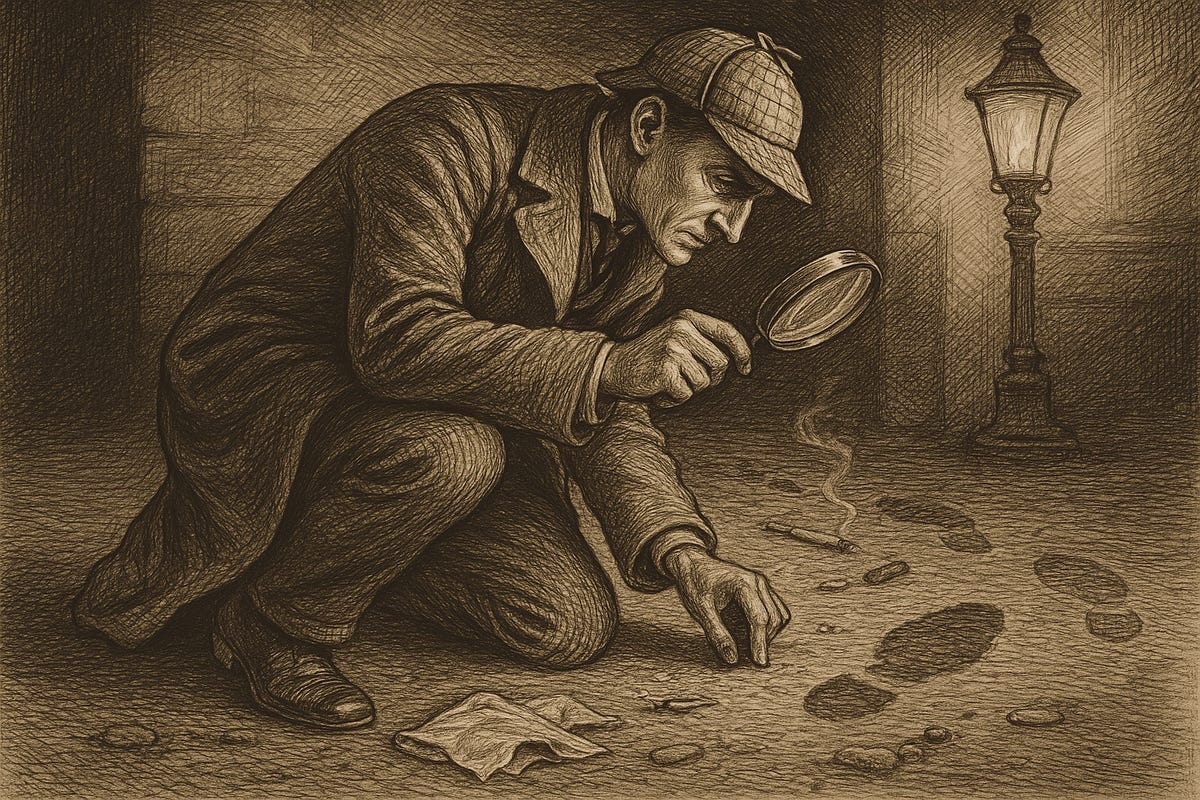
Ross and Burmann both have reason to be suspicious of each other. Burmann initially thinks that Ross’s theories about the case are the musings of a lunatic, while Ross is unimpressed by the Inspector’s misguided focus on motive. Ross considers it his responsibility to educate Burmann on the best course of action: “I told him pretty frankly that he wasn’t tackling this case on the right lines.” Yet Burmann is resistant to Ross’s suggestions, at one point commenting: “It has never been my way to do Sherlock Holmes stuff with a magnifying glass, crawling about carpets.” As the case continues, there is a grudging acknowledgement of each other’s contributions to the investigation, and we are left waiting to discover whose theories will be vindicated in the end.
The sections narrated by Noel Ross are the most enjoyable parts of the book. His interactions with others, and his inner monologues, provide ongoing entertainment. He is definitely independently-minded, often lacking sympathy and self-awareness in his interactions with others. His behaviour is also a continual source of exasperation to his wife June. In real life, I would probably find him irritating, but as a narrator he’s a very good companion, balanced by the steady predictability of Burmann.
The mystery itself is engaging too. Cobb gives us a good selection of distinct suspects, in the form of the other residents of the hotel. There are a few moments where new information significantly changes the course of the investigation, shifting suspicion from one suspect to another, and raising fresh questions about motive. Both Ross and Burmann pursue some wrong avenues before the actual method is revealed. And there’s not much padding: it all happens in just 168 pages.
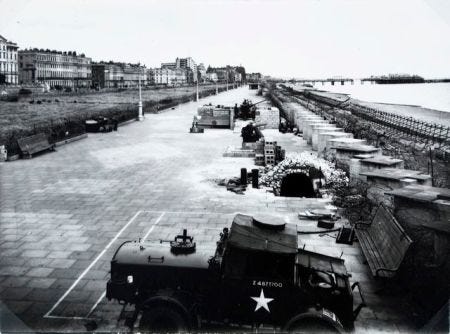
I also appreciated the wartime setting, which Cobb was himself in the midst of while writing the book. The realities of life on the Home Front are never far away. At the beginning, we’re told that Noel and June’s choice of the White Cliffs Hotel was partly constrained by circumstances: “Our hotel had looked the best of the five that were still open in the town—five out of about forty.” The town’s promenade is filled with barbed wire, rusted and draped with seaweed, and its boarding-houses are mostly either closed or providing accommodation to soldiers. In the evening, the hotel bar fills up with men from the RAF camp nearby. And we get introduced to the world of black market clothing coupons too.
A final wonderful part of the book is this vivid description of someone swinging back on their chair, which shows something of Cobb’s use of words:
Carmichael, a tall, heavily built man, suddenly swung his chair on to its back legs and dexterously saved himself from crashing backwards by hooking his toes under the drawers on either side of his desk. This acrobatic feat, though alarming to the spectator, was skilfully and safely performed, apparently as the result of long practice: and when the balance was nicely adjusted, Carmichael spoke in the casual tones of a man entirely at ease.
Overall, this book is an excellent piece of double detection, which definitely makes me want to read more by Belton Cobb. Maybe someone could arrange some Cobb reprints soon?
Verdict: ⭐⭐⭐⭐⭐ (5/5)
By the time he reached 18, Tunbridge Wells had officially been renamed Royal Tunbridge Wells by Edwards VII. I’m including this information mainly for the other pedants who read this Substack.
From the online addenda to Hubin’s crime bibliography: http://www.crimefictioniv.com/Part_34.htm.
One of the few facts about his life mentioned in his brief biography in The Times, 19 August 1971.
You can read a bit about Ruth Cobb’s illustrative career here: https://marchhousebookscom.blogspot.com/2015/10/ruth-cobb-guest-post-by-david-redd.html.
Ed Harris, The Footballer of Loos (The History Press, 2009), page 51.
Puzzle Doctor has compiled a complete bibliography of Belton Cobb’s detective fiction: https://classicmystery.blog/2021/10/07/belton-cobb-a-bibliography/.
Berkeley’s admiration is mentioned in Malcolm J. Turnbull’s biography Elusion Aforethought (Bowling Green State University, 1996), page 104. The Golden Age of Detection Wiki quotes a 1950 letter from John Dickson Carr to the Unicorn Mystery Book Club News, which begins: “I hope that I may be allowed to comment on the remarks of Mr. Belton Cobb, who is English and calls himself a writer of detective stories. (At least, he does in his books.)”
The Police Journal 40 (June 1967), page 257.
Again, I’m indebted to Puzzle Doctor for his bibliographic work here.
Twentieth-Century Crime and Mystery Writers (St Martin’s Press, 1980), page 322.
The third edition includes a list of writers who have appeared in previous editions. Other authors considered unworthy of an entry include E. F. Benson, John Bude, Glyn Daniel, Macdonald Hastings, C. Daly King, Christopher St John Sprigg, Ethel Lina White and Victor L. Whitechurch.
Also, I can never resist a good WWII mystery!
What a perfect bookstore find! The comments about Cobb's long career are somewhat damning but I'm definitely checking out his early efforts.