
Lessons in Crime
Academic Mysteries

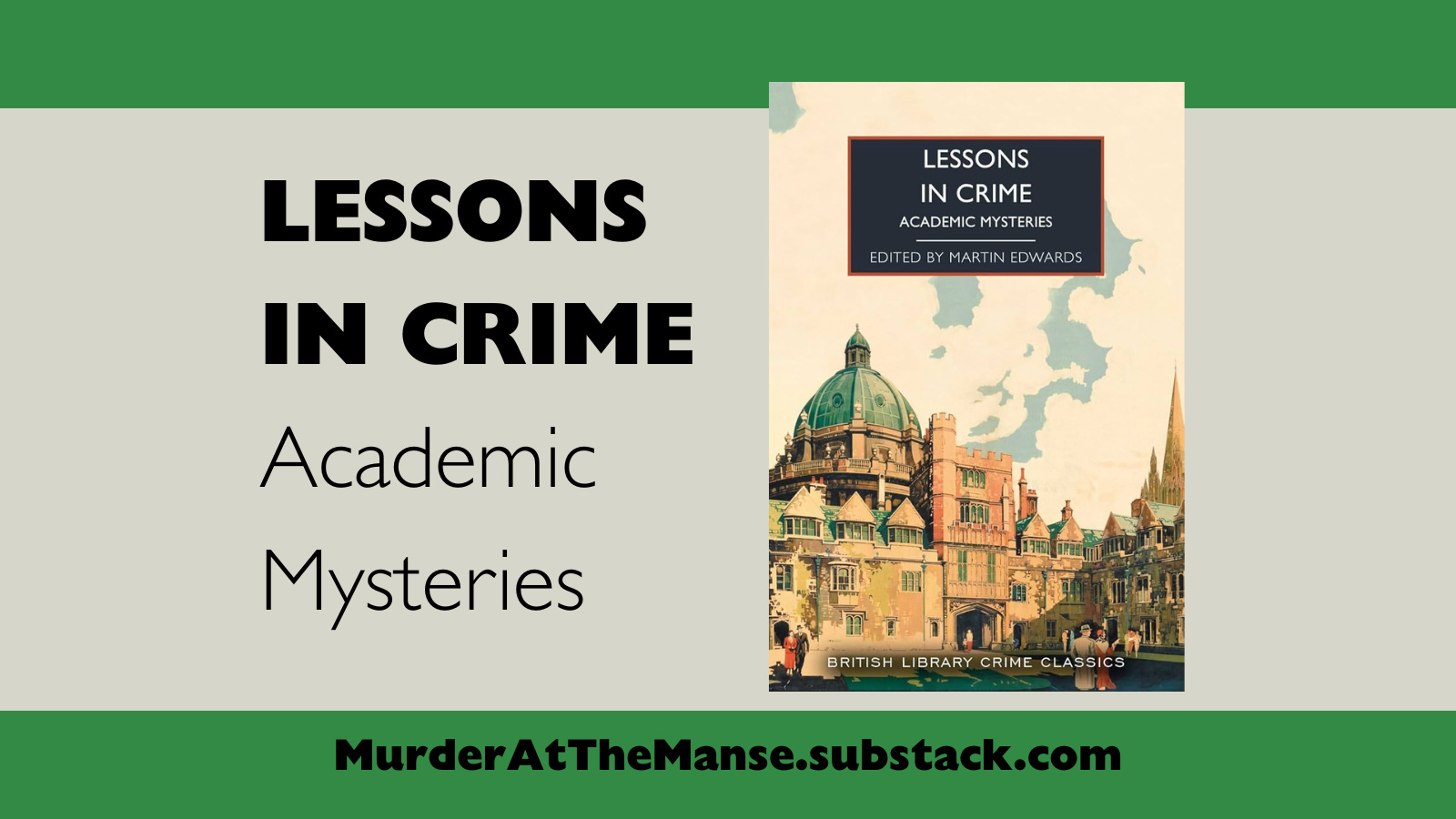
As Mrs Manse approaches the end of her teacher training course, it seemed appropriate to borrow a copy of the 2024 British Library anthology Lessons in Crime, featuring 15 stories set in the world of education. Surprisingly, none of the stories are set in Welsh comprehensive schools. Instead, about half take place in English private school settings, where college walls often enclose a volatile atmosphere of rivalries and tensions. There are also a handful of crimes at university, one at an adult education centre, and a story about a resident governess with an Oxford MA to her name. I had read three of the stories before, but the rest were new to me.1
As Martin Edwards notes in his introduction, the relative profusion of private rather than state school settings in classic crime is largely explained by the fact that “authors were writing about what they knew.” Many Golden Age writers were formed in a fairly elite educational milieu. The contents of this anthology are noticeably dominated by private school graduates: H. C. Bailey (City of London School), Arthur Conan Doyle (Stonyhurst College), Henry Wade (Eton College), Dorothy L. Sayers (Godolphin School), Michael Gilbert (Blundell’s School), E. W. Hornung (Uppingham School), Michael Innes (Edinburgh Academy), Malcolm Gair (Stewart’s College), Colin Watson (Whitgift School) and Edmund Crispin (Merchant Taylors’ School). Bailey, Wade, Sayers, Innes and Crispin are also all Oxford graduates.
This anthology is, chronologically speaking, an unusual addition to the British Library Crime Classics series: most of the stories were written post-1950 and the best represented decade is the 1970s. One of the most recent tales is by Jacqueline Wilson, who I was surprised to find in a crime anthology. I only know Wilson as a children’s novelist, responsible for titles such as The Story of Tracy Beaker, The Suitcase Kid and Girls in Love. It was interesting to learn that she began her career in the 1970s with a series of psychological crime novels. In fact, Martin Edwards argues, “it’s entirely possible that, had she continued to work in the genre, she would have rivalled Ruth Rendell.”
Although I enjoyed the strong unifying theme of this collection, I found the overall quality of stories lower than average for a British Library anthology. A few are especially uninteresting, namely those by E. W. Hornung (who I often struggle with), Malcolm Gair (who gives the game away with his title) and Edmund Crispin (a controversial opinion, perhaps). There are still a number of very good stories, though — I’ll write about my three favourites below.
Michael Innes — Lesson in Anatomy (1946)
Michael Innes was well-placed to write academic mysteries, as a long-term lecturer in English in Leeds, Adelaide, Belfast and Oxford.2 Under his real name (J.I.M. Stewart) he produced scholarly works on Shakespeare, Joyce, Kipling, Conrad and Hardy. While en route to Australia to take up a professorship in 1935, he completed his first detective novel, Death at the President’s Lodging, in which Inspector Appleby investigates a murder at the fictitious St. Antony's College. Academic settings recur regularly in his work, including The Weight of the Evidence (1943), Operation Pax (1951), and Old Hall, New Hall (1956).
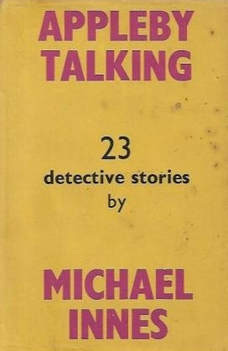
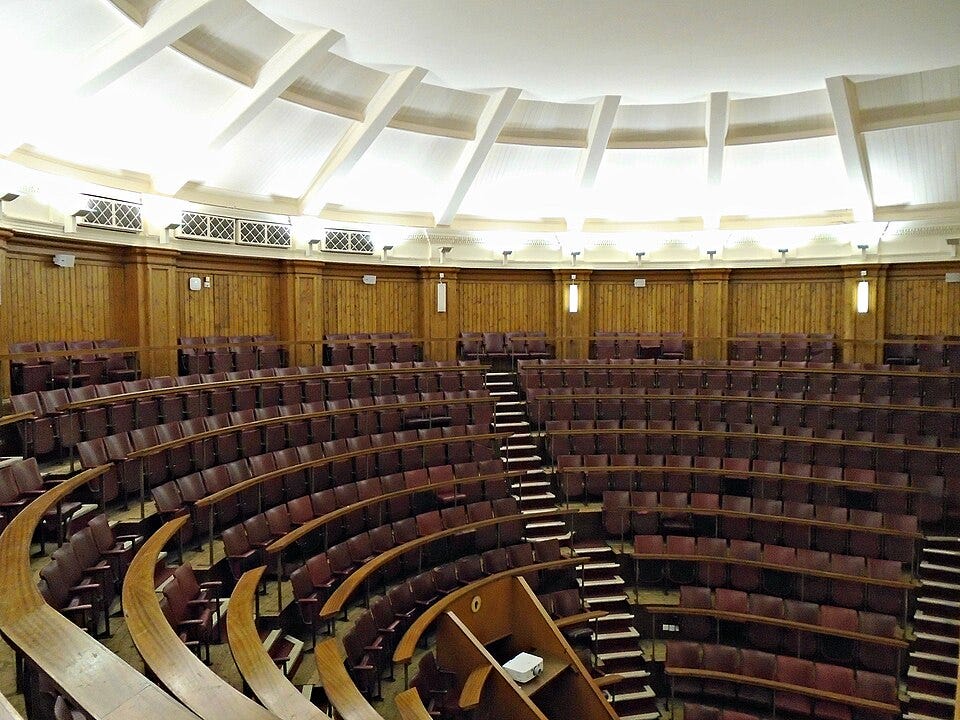
In “Lesson in Anatomy”, first published in 1946 in Ellery Queen’s Mystery Magazine and reprinted in Appleby Talking (1954), we find ourselves in the anatomy theatre of Nessfield University.3 Professor Finlay is presenting his highly-anticipated final lecture of the year, the one time where “he yielded his taste for the dramatic.” Each year, the lecture is accompanied by pranks from the students, on this occasion including the release of a vulture. Partway through Finlay’s anatomy lesson, the theatre is suddenly plunged into darkness. When the lights are reilluminated, the cadaver has been replaced by the Professor’s own dead body. Detective-Inspector John Appleby is called in to dissect the evidence.
From the very first page, it’s clear that we’re in for a treat, as Innes conjures up a bizarre and chaotic atmosphere in the formalin-scented theatre. The story is packed with vivid descriptions, including some appropriate gruesomeness. We are introduced to an eccentric cast of characters, including Albert the disapproving dissecting-room attendant and Sir David Evans, “Nessfield’s very Welsh Vice-Chancellor”. Innes provides us with a satisfying amount of investigation for a short story, including a dramatic reconstruction, all leading to a clever solution. I wasn’t overly enamoured with Death at the President’s Lodging, but I’ve been more impressed with Innes’ short story output, and this is a particularly enjoyable example.4

Joyce Porter — Dover Goes to School (1978)
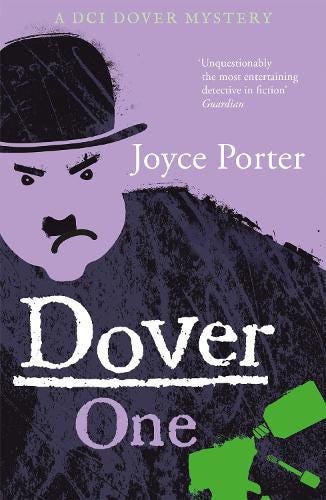
Joyce Porter is an author who is completely new to me. Born in the Cheshire village of Marple, which gave its name to Christie’s second-best sleuth, Porter spent 14 years in the Women’s Royal Air Force before devoting herself to full-time writing.5 She specialised in comic crime, with her first three novels introducing DCI Wilfred Dover, an outrageously unprofessional detective whose CV is summed up in the first book with the words: “The fact that his career as a detective had endured, and even flourished in a mild way, was almost entirely due to the fact that most criminals, incredible as it may seem, were even more inept and stupid.” Dover appeared in 10 novels and 11 short stories, collected in 1995 under the exotic name Dover: The Collected Short Stories.
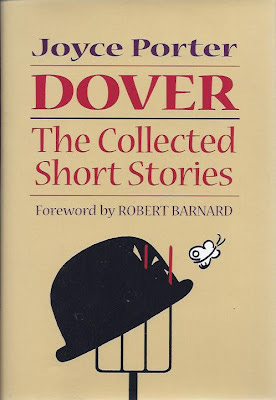
The 1978 case “Dover Goes to School”, first published in Ellery Queen’s Mystery Magazine, opens in a bathroom at Skelmers Hall College, an adult education centre where a small cohort has gathered for a weekend course on iconography under the tutelage of Professor Ross. One of the students, Rupert Andrews, is now lying on the bathroom floor, murdered. Andrews was not well-liked, so there is a long list of potential motives among the weekend guests of Skelmers Hall, including Professor Ross, “who moved with the preternatural leisureliness of a giraffe”, and Miss Betsy Gallop, “a woman of strong character, loud voice, and a distinct aroma of goat”.
I’m not sure if I could cope with a novel-length case with DCI Dover, but in a short burst, his disagreeable demeanour is wonderfully entertaining. He’s described as someone who “really worked at being ungracious” and “liked seeing people squirm”, and also enjoyed a “preprandial nap but his superiors at the Yard had been hounding him a bit recently.” I also enjoyed the unique setting, which made a change from the private schools and universities elsewhere in the collection. Underneath the humour, there was still a serious and satisfying mystery, with suspicions shifting between the different guests. In fact, I enjoyed this so much I’ve added the collected short stories to my wishlist.
Miriam Sharman — Battle of Wits (1967)
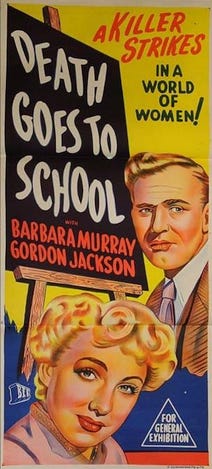
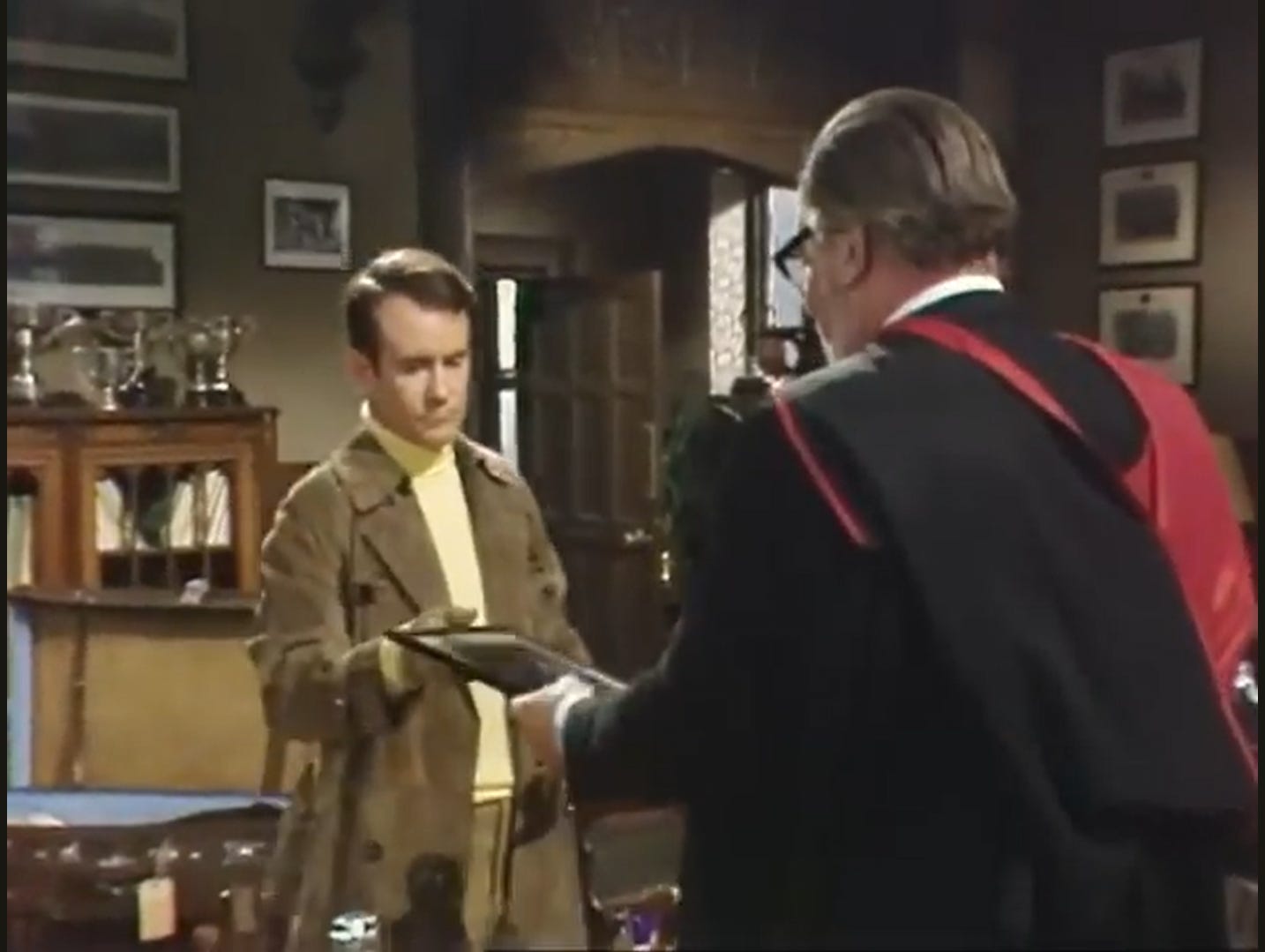
Miriam Sharman is another author I had not encountered before. Interestingly, her first novel, Death in Seven Hours, was set in a girls’ school. Published in 1952 under her pseudonym Stratford Davis, it was then adapted by the author as a screenplay, released on the big screen in 1953 as Death Goes to School. Martin Edwards highlights an amusing line in the film, where a suspect comments that during the time of the murder they were busy reading a thriller called Death in Seven Hours! Her 1967 story “Battle of Wits”, first published in Ellery Queen’s Mystery Magazine, was itself later adapted for television by Roger Marshall, as an episode of Orson Welles’ Great Mysteries.6
The story’s “battle of wits” is a face-off between a headmaster and a father. Richard Lumsden’s tenure at the school has come to an end and he is about to head to the airport for “a leisurely tour abroad”. A man arrives, giving the name Gregory Dean, and confronts Lumsden about a boy who had been expelled. To make matters worse, “he was hatless, an informality that brought a frown to the headmaster’s brow.” From the headmaster’s perspective, the boy was “an incorrigible thief”, but the father is distressed by the unforeseen consequences of the expulsion. He has now come to take revenge. The two men engage in a mental tug-of-war as Lumsden attempts to thwart the intruder’s plans. Will he succeed?
This is a thrillingly tense story that unfolds in just a single scene with two characters. The pacing is perfect: After an unassuming opening, Sharman gradually increases the tension by revealing the background to the father’s visit. She then cleverly maintains the suspense as the battle of wits unfolds. There is one particularly taut section where, within the space of a few pages, I changed my mind multiple times about how the battle would end. The tension then slackens for a short while before the final few paragraphs, which are masterful. Sadly, I think Miriam Sharman only wrote a handful of short stories. I’d be interested to see how her talents transferred to novel-length thrillers.
Overall verdict: ⭐⭐⭐ (3/5)
Have you read Lessons in Crime? Which were your favourite stories? Let me know in the comments!
“Murder at Pentecost” by Dorothy Sayers is in her 1933 anthology Hangman’s Holiday; “The Gilded Pupil” by Ethel Lina White is found in the Crippen & Landru collection Blackout and Other Stories; “Dog in the Night-Time” by Edmund Crispin is included in the 2021 Cecily Gayford anthology Murder on a Winter’s Night.
Biographical information from The Oxford Dictionary of National Biography: https://www.oxforddnb.com/display/10.1093/ref:odnb/9780198614128.001.0001/odnb-9780198614128-e-55756.
Not to be confused with Nestfield University, the setting for The Weight of the Evidence.
Death at the President’s Lodging is the only Innes novel I read, and that was 10 years ago.
The Marple fact comes from Martin Edwards’ introductory comments.
At the time of publication, available to view on YouTube.
I count Michael Innes as one of my top 5 mystery writers. Thanks for this update on some others.
The Dover short stories cover is beautiful! I found myself chuckling at the lines you quoted, so immediately added this to my to-read list. I remember reading and liking The Gilded Pupil in a different anthology: Ms Murder, a collection of crime stories with female leads. That's a good one too, btw.