
Four Past Four
Forgotten Book #5

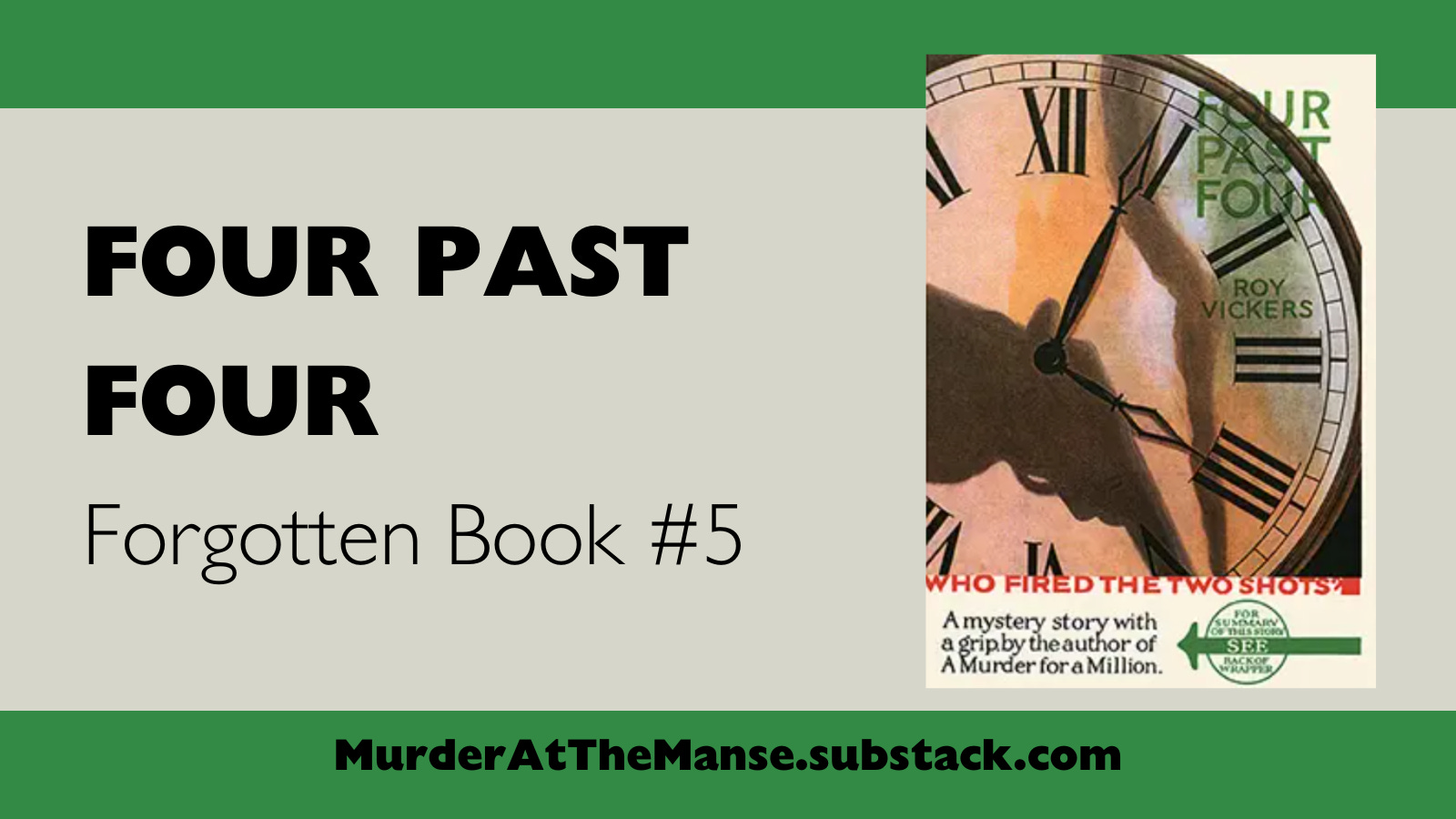
This is the fifth instalment of my occasional Forgotten Book series, where I review some of the less-remembered items on my TBR shelves. Today, we’ll be exploring the 1925 Roy Vickers novel Four Past Four, which (as far as I’m aware) only has one other modern review online, on the Dead Yesterday blog.
As an author, Roy Vickers is still well-remembered for a series of short stories he wrote featuring Scotland Yard’s fictional Department of Dead Ends. The Department houses an inventory of miscellaneous objects with potential connections to unsolved crimes. This random collection enables the indefatigable Inspector Rason to stumble across solutions to dead-end crimes. These cases have been described as “the best detective short stories of the 1940’s.”1 Whether you share that assessment or not, I’ve certainly enjoyed reading several of these stories. Roy Vickers was an entertaining and skilful short story writer.
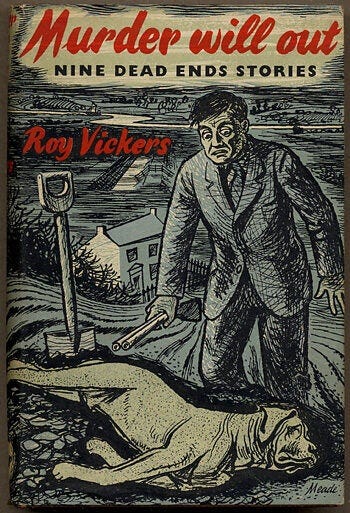
Alongside these well-regarded short stories, Roy Vickers also produced a large number of mostly-forgotten novels across a forty-year career. Julian Symons, who commended the Department of Dead End stories, was less impressed with these books, writing in Bloody Murder: “Vickers wrote many crime novels from the twenties onwards, but these books bear no mark of being produced by the same man who wrote the short stories.”2 I’m not sure if Symons had read Four Past Four when he made that comment, but based on my experience, I don’t think it would have altered his judgement either way.
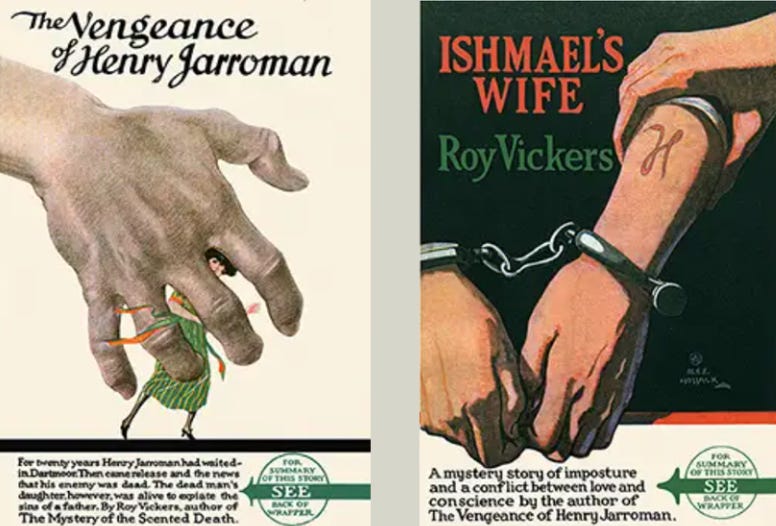
Four Past Four was the author’s third book to feature detective James Segrove, following The Vengeance of Henry Jarroman (1923) and Ishmael’s Wife (1924).3 First serialised in the London Evening News between March and May 1925, it was published in the UK by Herbert Jenkins later that year, but didn’t appear the other side of the Atlantic for another 20 years, when Jefferson House finally shared it with American readers in 1945. In October of that year, the novel was also included in a 3-in-1 omnibus edition distributed by the Detective Book Club, along with You’ll Be Sorry! by Samuel Rogers and The Lost Caesar by Ruth Fenisong. Vickers was a popular author for the Detective Book Club and his work featured in 12 of their triple omnibuses.4
The book’s title, Four Past Four, refers to a significant time in the so-called Barslade Case. At 4.04pm, partway through a cricket match at Barslade Manor, detective James Segrove receives a phone call from Clare Charters, a stage actress living nearby on Exmoor. Clare claims that her husband has been shot by a burglar, and then the phone call ends with a scream. Rushing to her house, Segrove hears another gunshot on his arrival at 4.24pm. In his inspection of the crime scene, it is clear that this 4.24pm shot is the one that killed Clare’s husband. No other bullet wound is found on the body, and no other bullet is discovered in the room. Clare herself has been knocked unconscious. But if the victim was shot dead at 4.24pm, why did Clare claim he was actually shot twenty minutes earlier?
Segrove is joined in his investigations by Dr. Birbeck, an American medical scientist who is also staying at Barslade Manor. They clash over their interpretation of the situation, especially the question of whether Clare is a guilty actress or an innocent widow. The other obvious suspects have solid alibis — Lord Leeford, the Lord of Barslade Manor, was speaking about horses on the radio, and Clare’s secretary Bode-Corbett was making a recording of the talk at a nearby cottage. The situation is complicated by a number of apparently contradictory clues, a shady jewellery deal, and an unexpected confession. On top of this, Dr. Birbeck doesn’t exactly help matters when he chooses to commit perjury at the inquest.

Although he does untangle all the messy threads by the end, I was not overly impressed with Segrove as a detective. His perceptiveness is accompanied by some serious errors of judgement — not least indulging Dr. Birbeck as his investigative sidekick. After one discovery later in the narrative, he is forced to admit: “I’ve made the most ghastly mistake.” There is, though, a depth to Segrove’s character, especially in his interactions with Clare Charters. Vickers enriches the interrogation scenes with Segrove’s thoughts as he analyses Clare’s character:
Obviously she was not sending for him for the purpose of telling him the truth. She was going to act. And unless he intended to tell her the truth, he would have to act too. Panic gripped him. He saw himself playing the part of himself—the Unsuspicious Detective talking to the Woman with a Secret.
These human interactions provide much-needed relief from the weight of physical evidence and accompanying discussion that Vickers provides us with. As the time-related title suggests, the investigation involves a lot of detailed analysis of times and alibis, as Segrove attempts to uncover what really happened at 4.04pm. The evidential inventory also includes multiple guns, some hydrangeas and an eye injury, as well as a chapter entitled “Mainly About Waistcoats”. For me, the complexity of detail overwhelmed the plot, detracting from some potentially more dramatic moments.
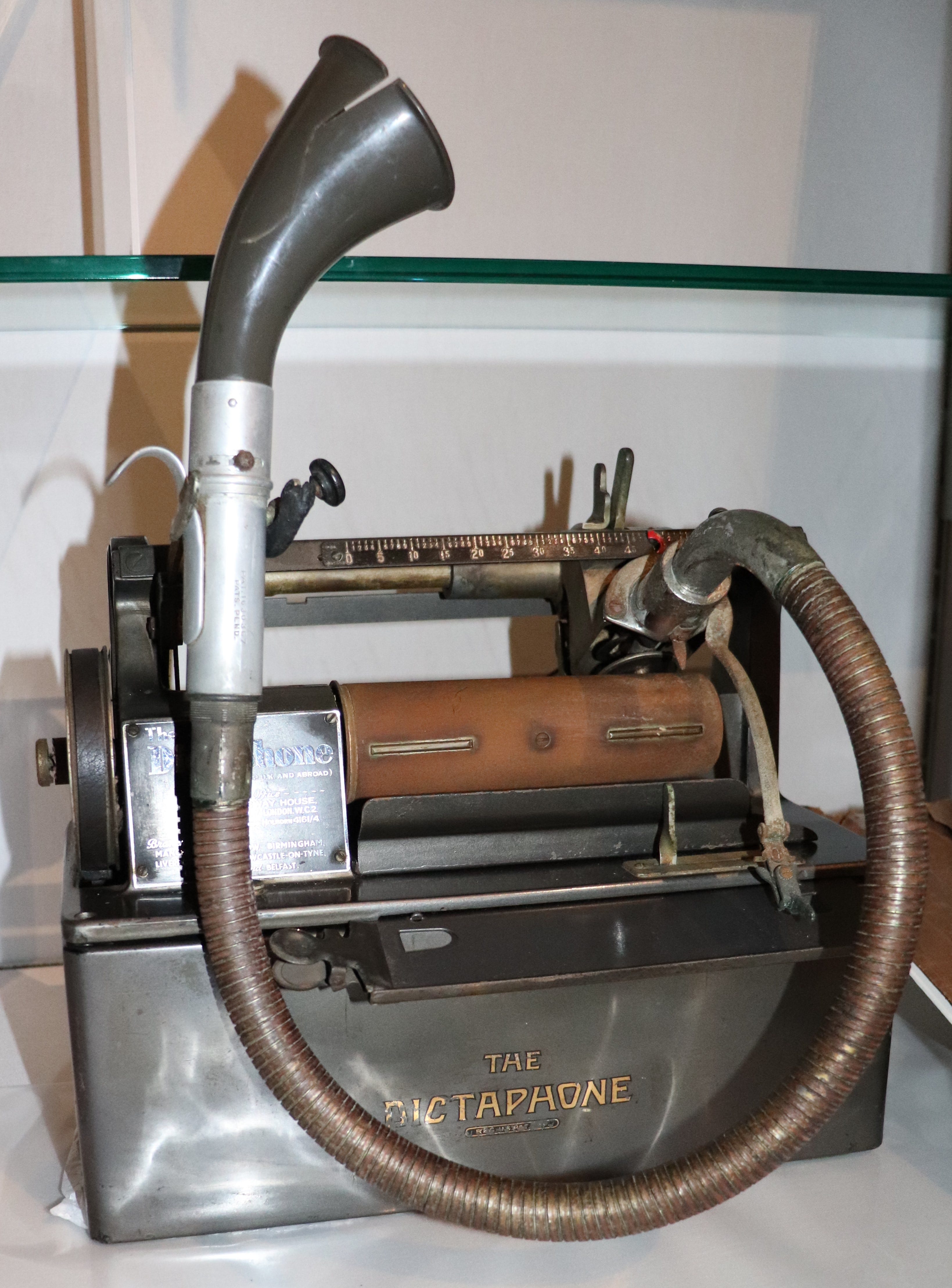
I did, though, enjoy some of the period details that Vickers provides as part of the investigation. One example is his description of the dictaphone that Bode-Corbett uses to record Leeford’s equine lecture on the wireless:
“When I speak through the speaking-tube, my voice is recorded on a wax cylinder… It struck Sir Robert Leeford that by holding the mouthpiece of the speaking-tube to the loud-speaker of a wireless set, a phonographic record would be made of whatever sounds proceeded from the loud-speaker… As I thought it possible that I might have some little trouble in connecting the dictaphone with the nearest electric lamp socket, I took a length of wire with me and a screwdriver…”
If you can persevere through the details of times and bullets, Roy Vickers does reward you with an interesting twist. This twist, though, involves a very lazy plot device, in which a key piece of evidence appears in a frankly ludicrous way. This definitely undermines the satisfaction ratings of the ending. In his contemporary New York Times review, Isaac Anderson was also unimpressed with the resolution: “The true explanation is rather hard to take, and it is based on evidence which most readers will find insufficient.”5
Having enjoyed several of Roy Vickers’ short stories, I was disappointed with Four Past Four. I will probably make another attempt with one of his later novels at some point, but I wouldn’t recommend this one. Other suggestions welcome. Or maybe I should just stick to the trusty Department of Dead Ends?
Verdict: ⭐⭐ (2/5)
Read in the 1945 Detective Book Club hardback omnibus.
Scavenger Hunt item: Clock/Timepiece
From Roy Vickers’ entry in Twentieth-Century Crime and Mystery Writers, 3rd edition (St James Press, 1991), page 1048.
Julian Symons, Bloody Murder (Viking, 1985), page 158.
In the online Encyclopedia of Pulp Heroes, Jess Nevins sums up James Segrove as “large and matter-of-factly competent, with an open glance and a subtly intense awareness. He seems friendly enough, but he will shoot and kill an unarmed criminal if the criminal seems to reach for a gun. See https://jessnevins.com/pulp/pulps/segrove.html.
See Gary Menchen’s excellent Detective Book Club checklist: https://www.pagesofpages.com/dbc/dbc_author_index.html#_V
23 September 1945. The other books reviewed in the same column were The Noose is Drawn by Willetta Ann Barber and R. F. Schabelitz and The Case of the Half-Wakened Wife by Erle Stanley Gardner. See: https://www.nytimes.com/1945/09/23/archives/criminals-at-large.html.
Very interesting. I have a copy of this, but it's unread by me. Might not hurry to read it on the basis of your review, even though I do like Vickers.